Pebbles Two
On building inclusive spaces

This second instalment of Pebbles reflects some thinking I did while facilitating a “Philosophers’ Lunch” in early April. (Yes: the apostrophe of ownership is correct because the monthly gathering has many philosophers, in the sense of there being people who have gathered to consider how to live; ethics, religion, common issues and current events, etc. Few, if any, of us have formal qualifications in philosophy.) Bear with me as I move through thought pebbles, I am not trying to convert you. :-)
There were two stimuli to this group of thoughts: First, an article appearing in the online site The Conversation, about the late-ancient philosopher Epicurus. Unlike other well-known philosopher contemporaries, he did not just discuss and teach with the elite and their children. He must have been well-resourced, ‘though, as he established a garden in which to meet, and invited anyone to attend and to discuss philosophy. This was radical at the time, as it included women and slaves: people at the time with only partial “person” status and restricted rights. Epicurus is often remembered for the word ‘epicurean” and the connection with pleasing of the senses. He is misrepresented in depictions of orgies and of the idea of pursuing pleasure above all else. This is a distortion: certainly, he did make the pursuit of happiness in this life (he wasn’t into ideas of an afterlife) to be important. However, it was about finding happiness in the everyday life; the small moments of enjoyment and connection, and this resonates well with current “mindfulness” thinking. I think Epicurus would be fine with a practice of gratitude. His circle of friends there would have given him a much wider set of perspectives on life to discuss, than his elitist contemporaries! Here’s one reason why diversity brings strength.
Perhaps his radical acts of inclusion earned him enemies, who disapproved of this upending of social structures that benefited the educated and elite. Perhaps that is why he was misrepresented in the history of some. That sounds awfully familiar: I recall the stories, still told today, of an itinerant Palestinian Jew, a teacher with a fire in his belly for connecting everyday people with the Divine and practising radical inclusion. He believed that what he called “The Kingdom of God” (yes, I know “kingdom” has problematic patriarchal and authoritarian ideas, but we have translations of translations), that this state of existence was open to all, which was very radical in a culture and time where people defined themselves on who was “in” and who was “out” with their God. (Thanks to the ideas expressed by Marcus Borg in his work “Meeting Jesus Again for the First Time” for this angle.) His inclusion and work naturally put him at odds with the authorities of the time, such as the Jewish religious leaders and the state of Rome, who had him executed utterly, thoroughly and with maximum pain and humiliation. That teacher is now regarded as a prophet by some, and by others as revelation of God themselves. Personally, I doubt that he set out to start a new religion, but his life shows remarkable and radical inclusion.
- But this is not, actually, a religious essay; it is a philosophical gathering of thought pebbles.
The second stimulus came from noticing a particular building that I walked past, when visiting a large country town, and from subsequent discussion with R, my brilliant elder offspring and all-round awesome human. The building was a medical centre, and what struck me was this: the whole building was well above ground level, but the ramp up to the entry deck was the default path. It was prominent and inviting. By contrast, there were steps, coming from a much smaller path that was tucked away. The default was the inclusive space. What sort of inclusion are we talking about? Women and slaves welcome? Just: everyone welcome, as much as possible. The medical centre would not just have patients with mobility impairment needing to access the building (and mobility impairment is so much more than a wheelchair). There would be people with a stroller or pram. There would be, R pointed out, people delivering things, with sack trucks or trolleys. Perhaps the staff too would have times when they broke an ankle skiing and needed crutches and a moon boot for a while. 😊 No-one using this path would have felt singled out or “other” by needing to take a special point of entry, and this is the point: it was just the default entryway. Sometimes this approach is called “Universal Design” in architecture, but it is about any public space. I found many points to inform and inspire in some writing by Stefanija Stameska, on the web page listed below.
People have many ways of needing to be included. Clear signs and obvious layout help those with cognitive disability, but also those with anxiety and who are prone to overwhelm; perhaps those with dementia who nonetheless would appreciate an outing at some point, or who need to keep an appointment somewhere. Highly reflective surfaces make it hard for those with issues of vision. High lift/elevator buttons unnecessarily remove dignity for people who can’t reach very high, for whatever reason. The chronically ill and those with neurodivergence might struggle with harsh lighting and loud sounds, and nowhere to pause and rest. Personally, I love good air quality! The lunchtime philosophers argued that they could see possible conflicts between the needs of various people, and that might well be the case. That does not mean that you don’t start from maximum inclusion as a starting point. A space that is clearly designed with your needs in mind says “Welcome!” and “You belong”, especially to those who have so often faced barriers. Half the population frequently find themselves having to queue to use the designated restroom in public spaces and at venues big and small. Individual rooms, each with a toilet and basin, allow for much-needed flexibility when needed, help people with young children, provide access for those with mobility issues and, importantly, remove the frankly ridiculous argument around trans and non-binary humans seeing to their needs in peace. Yes: building individual restrooms is more expensive at the outset, but flexibility of use alone is worth a lot of money in many venues and public spaces.
Inclusion does not, as some fear, result in holding back society. It absolutely does not mean that any and every behaviour is to be allowed. It does bring us strength, as we empower people to thrive and to contribute as members of society.
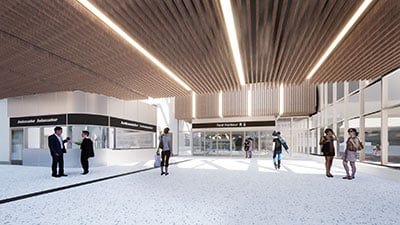
Embracing inclusivity and redefining accessibility in architecture
Oh my goodness so many thoughts! You have expressed this so well and it makes me want to get out my sketchbook and go back to trying to design the ultimate home.
The thing is… places designed for disability inclusion feel better for everyone. My parents’ hardware store used to be in two old buildings with a door cut in the mutual wall. Counting storage areas, it was on 8 different levels. (Not 8 stories high! Just 8 different elevation changes.) When they moved it to the old liquor commission outside of town, it became 1 level. The relief! Work became so much easier. (Way less fun though. I grew up in the old store and it was totally amazing to play in. And I only just learned there was a second hidden stairwell in the kitchenette! How did I miss that?)
“Universal Design” indeed. Maybe add some crawlspaces, trapdoors, ladders, or secret hideaways for the kids. 😉
What I find so frustrating is that the world deliberately functions to make people uncomfortable, then exploit us or sells us the solution. Cosmetics, plastic surgery, and fashion are the obvious offenders. But if you eat in a casino (Weird Al was performing- best concert I’ve ever attended!) you will observe how the back of the seat is designed to make you lean over your plate, the table is subtly too high, making you want to shovel in your food and get out, the view is of the VLTs, and the most prominent part of the breakfast buffet is the soft serve ice cream machines. The eggs and beans took two laps around the buffet to find. Even grocery stores with their harsh lighting, loud music, high shelves, and jarring packaging are designed to make you anxious instead of mindful so you buy too much of things you wouldn’t have chosen had you thought about it and get out of there. My local store just redesigned so instead of flow to the back of the store where the milk is (🙄), you now hit a wall of chips and cheesies that you have to deliberately navigate around to get to the milk aisle. And on the other side is cereal- more junk, more stress. (Cereal used to be in the middle- you could just skip it.)
So while old buildings were built by myriad people who were likely just trying to minimize effort and material use, many of the barriers today are deliberate capitalist constructs to make us uncomfortable, insecure, and vulnerable.
…I think I wandered from your point. But now I can’t remember because the thoughts got flowing and I can’t refer back to your essay. 😝
Anyhow. Good morning from Nova Scotia! May you sleep well. I need to get dressed and go to the farmers market. 😉