On finding a door,
Open wide

It’s not just being invited into the circle; it’s finding you can move in effortlessly, with a feeling of natural belonging.
A few days ago, I was privileged to attend a memorial event for a shining human being. Although she lived fewer than half of the years that many get, she did so much with her time that some of us wondered what we’d been doing with our own lives. She was Dr Ellen Fraser-Barbour, and her story is not mine to tell, but feel free to look her up. I’ll add a link at the end, so you can learn a little about her if you wish.1 I will add this: as well as academic, artistic and work achievements, she achieved deep friendships and family connections, being a beautiful light and companion on life’s journey for many. These connections are important.
Her lovely mum Susie sings in the same choir as me. While the devastation of her daughter’s death was still new and raw, with great courage she came to choir, and we sang to her in a musical hug, a holding-together, a small bowl of love that would not fix things but which (we hoped) helped a little. This is what the choir does. When her daughter’s memorial was being planned, Susie asked whether some of us might come and sing a few songs. – So quite a few of us did. We had three songs at the event, to punctuate sets of tributes and photographs, singing our hearts out and singing our love into the hearts of those present.
All of that is by way of setting the scene. The most important people at the event were Dr Ellen, her family and those who knew her well. Some of us arrived as virtual strangers, but: we found a door open wide.
Dr Ellen’s memorial was one of the most inclusive events I’ve ever attended. Access to the building was built in and unremarkable; no special door was needed if you had wheels. The door was simply wide and welcoming. Each person was greeted, offered a sticker to make a name tag, invited to sign a book and to take a card printed with a copy of one of Ellen’s paintings, with the event order on the other side. As my brain stumbled for a moment, I was met with patience and kindness. Later, when the queue became long, the greeters changed their setup to shorten people’s waiting time, still offering all the welcoming things.
Inside, there was room to move, regardless of mobility challenges. There were refreshments brought with love by many, including many things for people with dietary requirements, which were labelled with ingredient lists and easy to find and reach. Toilets of course were accessible. There was a quiet space with lower lighting and cushions, as well as other slightly quieter spots with screens, to watch the event from further away. Fresh air and green, with places to sit, greeted people who went outside.
The humans in attendance were glorious in their diversity. Rainbows popped up here and there. Hair in all sorts of colours matched clothes in autumn tones (Ellen’s favourite colours). Some stood, many sat, some wheeled and some moved about as they needed, raising no eyebrows. An Auslan interpreter worked all through the event alongside the speakers, adding to a camera feed with real-time speech to text function. Near me, someone sat with their hand on a cushion. Two others took turns to sit by them, signing onto their hand.
For once, I was not the only person wearing a mask inside; this was clearly normal for some, and accepted. Needing to rest at any point was also normal and unremarkable. I did not feel weird or needy at all (Edit: I know this is internalised ableism). By the time the event started, my meds had kicked in and I could stand for the choir segments, which made things easier (it was only for short bursts anyway). Importantly, the brain fog lifted and I was able to take things in and to respond more quickly.
It was still tiring and a bit overwhelming. I was still glad to be leaving, when it was time. I was struck anew though, by how welcoming the whole event was. Never was there a sense of extra trouble; accommodations were simply there. OK: I do understand that probably you wouldn’t hire an Auslan interpreter for every occasion, unless you knew that you were expecting someone who would appreciate it. However, there is much that can be done that simply signals inclusiveness, without someone having to ask for things. A door wide enough for the mobility device? Of course – it’s just there, and it opens easily, and there are no steps or big bumps. Food you can eat? Naturally, and you are welcome to bring your own safe food as well. Quiet, softly-lit withdrawal spaces, and acceptance of movement? We’ve got it. – And we don’t make faces or comment on masks, either. Indeed, we provide fresh air as we can.
I learned a little while ago about inclusive architecture or “Universal Design”, which is included in a piece I wrote about earlier; I’ll put a link to that at the end, too.2
Usually it takes a prompt for us to realise that there is more that we could do, to be inclusive, because usually we don’t notice barriers that are not in our own way. It’s good to listen when people give you clues about what you might do. Importantly, it is lovely to feel thought of before you have ever entered a space; someone has simply anticipated a need and there is the accommodation, the response, as a natural part of the space. There is the attitude that simply says: welcome. You belong here.
If you’ve ever felt like your needs are a nuisance or that you don’t belong, this is gold.
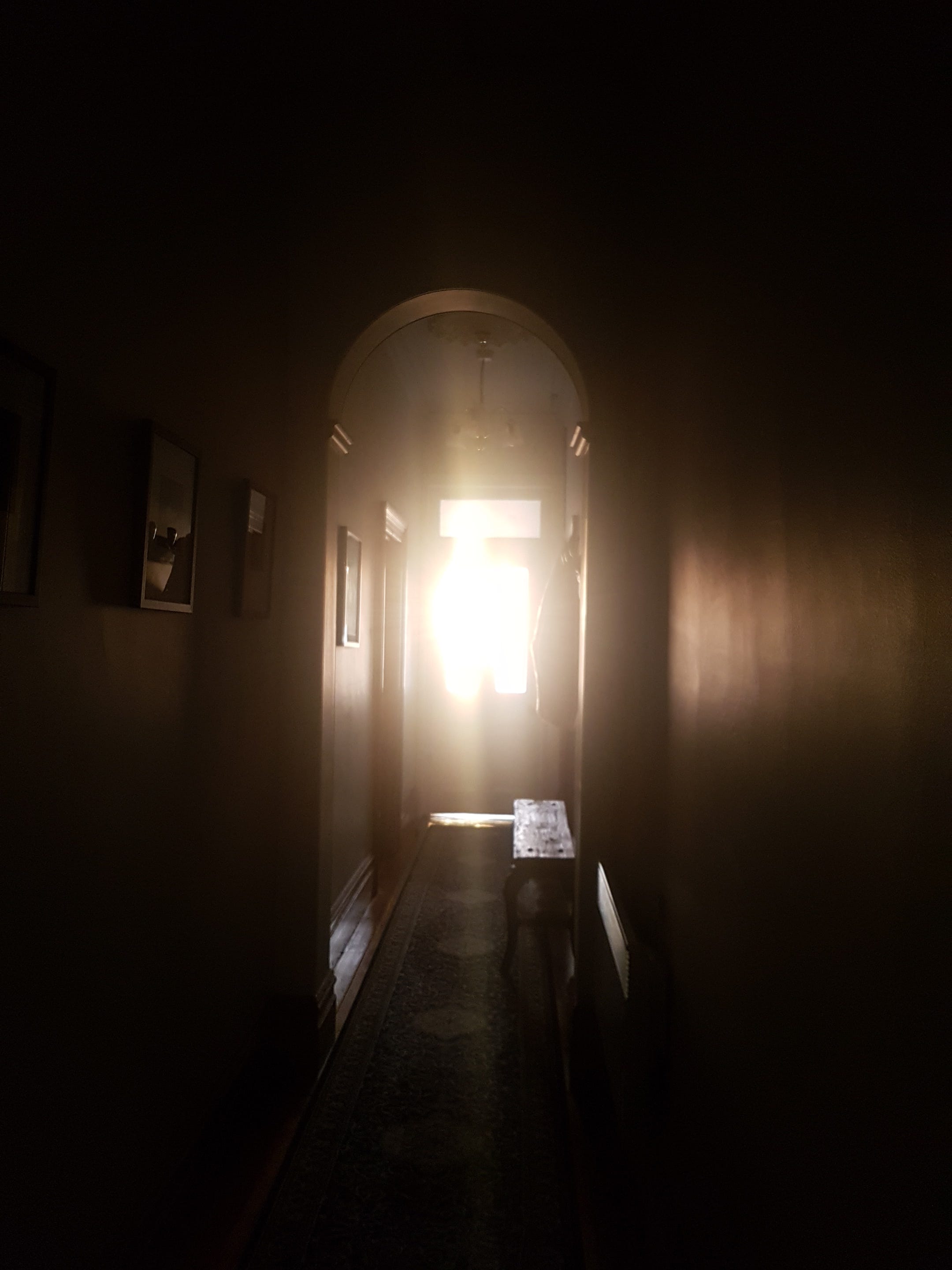
Welcome. The door is open wide.
1 One of several articles online: ABC News - tributes flow
2

(Photo: a narrow, dim hallway, ending in a door glowing with light shining through it.)
Thank you for putting this experience into words that could be shared here. We are too often horrid at grief, at choreographing time and space so that it might happen in rich and meaningful ways, snot and all, when need be. And sometimes, we do the opposite, forgetting that a celebration of life isn’t all celebration; there are sorrows and unhealed wounds. How beautifully you laid this out for us. You remind us that the creating of the space, the attention taken to detail, and the welcoming nature of it must be the first principle if those gathering are to be able to move through the complexity of celebrating someone’s inimitable life while sitting with the sorrow of its utter absence.
I loved this and Dr. Ellen sounds like she was a delightful human being. I fell down quite the rabbit hole this morning reading first about her and then an article she had written and wanted to keep going. She was compelling and I’m impressed by how fully she lived the life she had.
That space sounds perfect. What a tribute.