Notice
The map, the signals

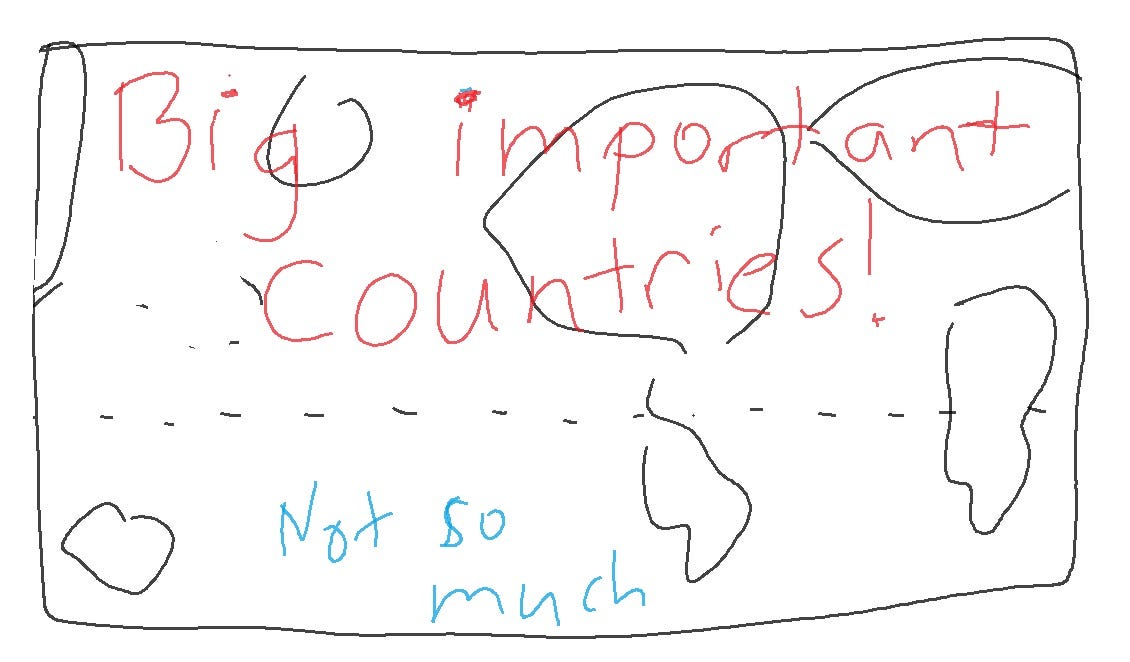
Today I noticed a map of the world: the frequently-seen flattened type, like the old Mercator projection, with Antarctica and a good chunk of the Southern Ocean cut off, the earth’s equator not in the middle but about two-thirds down. Versions of this map are still in wide use, even though it’s been known for years that it distorts our view of the world. The equator is supposed to be in the middle!
Without a doubt, these maps preference the north of the planet, expanding the apparent size of some northern countries while taking the viewer’s attention away from the south. Without a doubt, it directs our attention to the north. What’s down south, after all? Oh, just a bit of ocean, and a few countries, mostly small and poor; much less important.
Other maps, like the Peters projection, aim to correct the land size distortion and, looking at this, you get to see just how vast Africa is. Australia too is much bigger than many northerners tend to think, and indeed some European tourists in Australia have encountered mortal danger from finding themselves with vehicle trouble and far from fuel, water and help, simply because they had an inaccurate view of the continent’s size. However, accuracy of relative land mass size isn’t just about correcting the egos of those in more powerful places, although it does feel more respectful to cause a northern map-viewer to notice the amount of countries that they rarely, if ever, think about. Accurate maps give us important context.
Significantly: if you include Antarctica and all the surface of Earth, you get to see that:
*there is a great deal of ocean on Earth*.
Earth is a blue marble from space; a beautiful blue-white marble, with land masses only visible when you get closer.
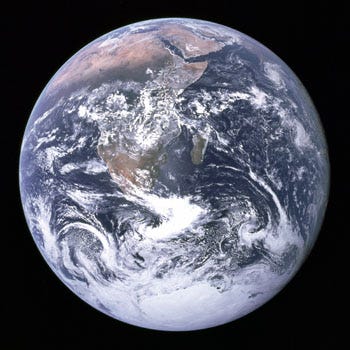
Notice all the blue. Notice too, all the spaces of island and country that often get overlooked in the news cycle, yet which have a part to play in our Earth’s systems.
Check out a map of ocean currents (with all the oceans featured in it), and notice how oceanic weather is a critical driver of climate; whether we live near it or not, it affects us deeply.
Remember the tidal bulges of Earth; how Earth bulges with the moon’s pull, having effects both strong and subtle on the creatures and systems, as surely as day and night.
Pay attention to the cues and the structure of the planet; you are a creature utterly dependent on it.
A few weeks ago, some of us attended a regular gathering called “Science in the Pub”, where researchers come to present some interesting findings, and basic background, in their field. At this one, an expert in circadian rhythms with light and dark, urged us to get outside more. He urged us to pay more attention to the amount of light outside, especially in the evening, slowly yellowing and dimming the lighting inside to allow the body to begin its sleep cues, some hours before actual bed.
Notice the whole of the world on a map. Notice the many places. Notice all the blue ocean and its significance. Notice the light and dark outside, and make room for soft light and full darkness.
I need to acknowledge writers like Neurofriendly Therapy who have been urging us to notice the tidal movements of energy and focus in our own bodyminds. As a very late-diagnosed autistic and person with chronic illness, I am still learning to notice what preserves and drains energy, taking action and resting accordingly if possible. Paying attention to how you feel, feels like a luxury that is only afforded to some, and I understand that. Still, taking time out from distractions, taking micro-breaks of even thirty seconds, helped me to begin to notice more subtle body signals, even when I was still in paid work. We are all of us creatures of the planet, and if we are fortunate enough to live near some green or blue (or “natural”) spaces, we have an opportunity to see how being there affects our bodymind, too.
I’m in the middle of reading “Health at Every Size” by Lindo Bacon, where the writer urges the reader to learn to pay attention to their body’s hunger, thirst and satiety signals. - And to feelings. Years of largely ignoring them through busyness and distraction, along with being hammered by food and weight-loss industries, means that many of us have to retrain ourselves to notice these, too. It’s a way of being kinder to our bodies that moves us gently and slowly towards better health overall (provided of course, that we have the privilege of choice and timing in food intake).
Here again is the prompt to notice: notice what energises and what tires. Notice your body’s signals to eat; notice the eating experience; notice the signals to stop. Notice when you are eating for reasons other than hunger.
One of the many wonderful things about the writing of Wake Lloire is their capacity to notice things of significance, that might at first appear to be small: noticing their need for stillness and rest; noticing beauty; noticing the lovely, the silly, and the whimsical; noticing the pleasure of food prepared with love; noticing uncomfortable emotions and letting them move through, with gentle care.
I invite you to notice:
Maps, and to where in the world your attention is being directed, and big, blue ocean;
light and dark; seasons and tides (Keith Aron writes so beautifully about the seasons in their notes).
Hunger, fullness, weariness and restlessness, energy tides;
Love and beauty.
Thank you for these gentle invitations to notice what's going on in the Earth and atmosphere around and in us...and also for the kind shout-out to my notes here on SS, Heather Lee. All of it is very much appreciated. 🌏💙💚🕊️
That’s one of the things I love about Wake, too.